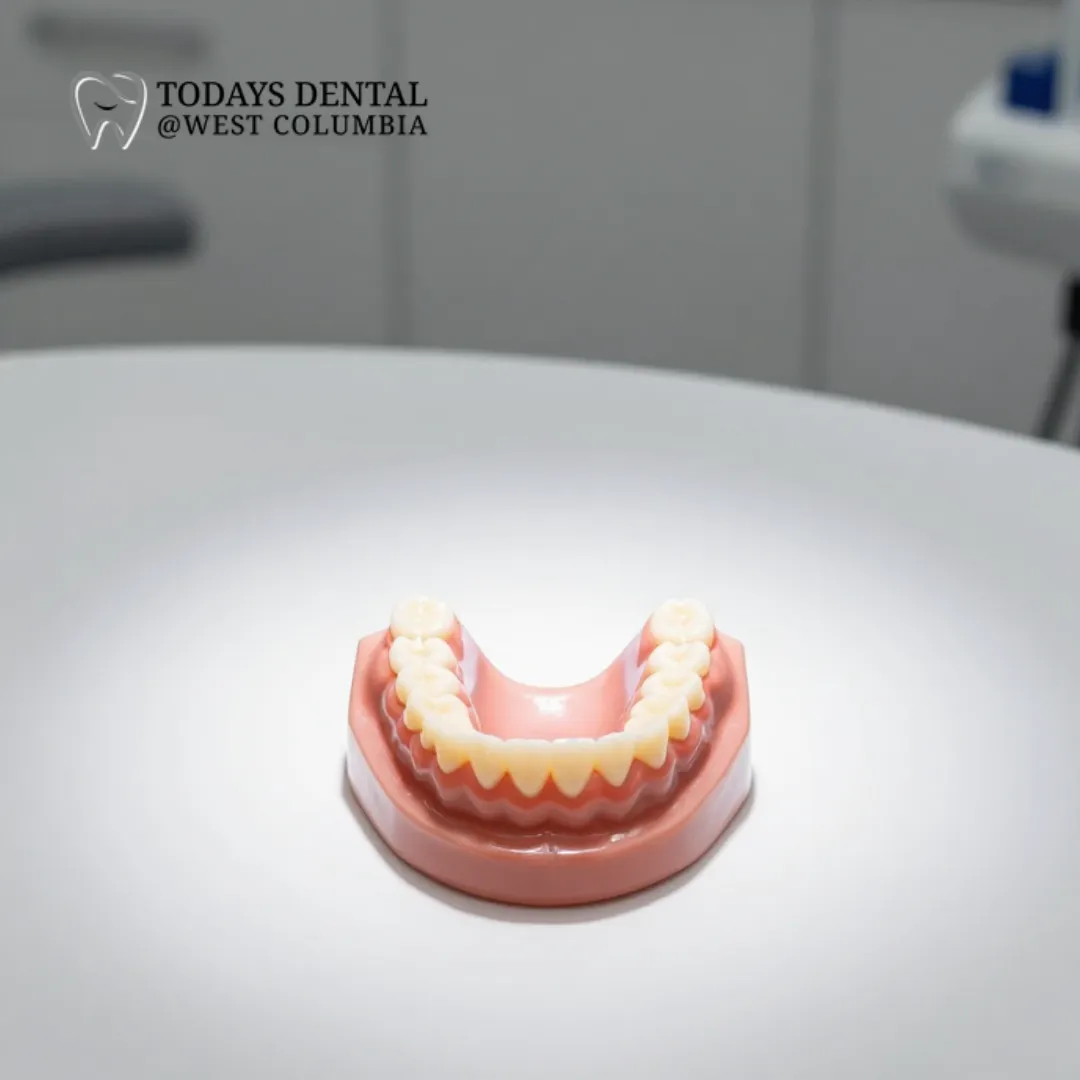
Dentures come in several types, and each one restores lost teeth a little differently. At Todays Dental West Columbia, we help patients across West Columbia and the greater Columbia area choose the option that fits their mouth, their budget, and the way they live. Here's how these prosthetics work — and how they brighten both your appearance and your day-to-day comfort.
Complete dentures replace all the teeth in an arch. They rest on the gums, support facial structure, and restore chewing function for patients who have lost a full upper or lower set.
Partial dentures fill the gaps where some natural teeth remain. They protect gum health and keep the remaining teeth from drifting out of position — one of the quietest but most important benefits of treating missing teeth early.
Implant-retained dentures attach to dental implants placed in the jaw. Because they anchor to bone rather than resting on gum tissue, they deliver a stronger bite, clearer speech, and a more secure fit. For patients missing an entire arch, full-arch restoration is often the most stable long-term answer.
Whichever type you choose, the goal is the same: better aesthetics, more confidence, easier oral hygiene, and a real improvement in quality of life.
Missing teeth do more than change your smile — they change the shape of your face. Without teeth to support it, the jawline loses definition and the cheeks begin to sag. Complete and partial dentures restore that support, so faces look fuller and more youthful.
Well-fitting dentures also bring back chewing power. Patients who had narrowed their diet down to soft foods can once again eat a full range of meals without discomfort — which matters as much for nutrition as it does for enjoyment.
That functional gain feeds straight into confidence. When speaking and smiling feel natural again, most people find it easier to engage socially. Quality dentures don't just restore a smile; they contribute meaningfully to overall oral health and comfort.
Tooth loss often makes certain sounds hard to pronounce. Dentures give the tongue and lips the surfaces they need to form words properly, and most patients notice their speech clearing up within a few weeks of adjusting to a new appliance.
The aesthetic side is just as real. A well-fitted denture restores the smile line and supports the gum tissue and jawbone underneath. Patients tell us they feel far more comfortable in social situations simply knowing their teeth look right.
Dentures restore chewing function, which makes it easier to enjoy a varied, nutritious diet. They fill out the cheeks and lips, contributing to a more youthful appearance. And with proper care, they serve as durable tooth replacements that support your broader oral hygiene routine.
Dentures provide structure that helps maintain the shape of the face and encourages proper jaw alignment. Properly fitted appliances reduce strain on the jaw joints and muscles, which improves comfort throughout the day. They also make it easier to clean and care for the gums, which helps prevent gum disease. Routine dental checkups keep the fit and function on track over time.
A secure fit lets you smile without second-guessing it. Patients regain the ability to eat their favorite foods, speak without hesitation, and take part in conversations they had started avoiding. For many people considering tooth replacement, that shift in daily confidence is the biggest benefit of all.
When you aren't wearing them, keep your dentures in a clean container filled with water or denture solution. This stops them from drying out and losing their shape. A few rules that protect the fit:
Sore spots, difficulty chewing, clicking, or a fit that has loosened over time all signal that your denture needs professional attention. Gums and bone change shape gradually after tooth loss, so periodic relines and adjustments are normal — not a sign that something went wrong.
Don't wait it out. An ill-fitting denture can irritate the gums and make everyday eating and speaking harder than it needs to be. Call 803-233-8177 and we'll get you in for an adjustment.
Choosing between dentures, implants, and other tooth replacement options comes down to your oral health, your bite, your budget, and your goals. Our team at Todays Dental West Columbia will walk you through each one honestly.
Phone: 803-233-8177
Address: 115 Medical Cir, West Columbia, SC 29169
Book online: Schedule a consultation
The main types are complete dentures (replacing a full arch), partial dentures (filling gaps around remaining teeth), and implant-retained dentures that anchor to dental implants. A dentist trained in prosthodontics fits all three.
Dentures replace missing teeth and support facial structure, which restores chewing power and gives your tongue and lips the surfaces they need to form sounds clearly. Eating gets easier and words come out sharper.
Yes. Dentures restore the smile line and support the lips and cheeks, and most patients report a noticeable lift in confidence once they've adjusted to wearing them.
Clean them daily with a soft brush, remove them at night and soak them as advised, keep up your oral hygiene and gum care, and come in for regular checkups so the fit stays right.
Dentures support facial structure and make oral hygiene easier to maintain. Paired with dental implants, they also help slow the bone loss that follows tooth loss.
Talk to a prosthodontist. They'll assess your oral health, bite, bone level, budget, and cosmetic goals, then walk you through how dentures compare with implants and bridges for your situation.
The main types are complete dentures (replacing a full arch), partial dentures (filling gaps around remaining teeth), and implant-retained dentures that anchor to dental implants. A dentist trained in prosthodontics fits all three.
Dentures replace missing teeth and support facial structure, which restores chewing power and gives your tongue and lips the surfaces they need to form sounds clearly. Eating gets easier and words come out sharper.
Yes. Dentures restore the smile line and support the lips and cheeks, and most patients report a noticeable lift in confidence once they have adjusted to wearing them.
Clean them daily with a soft brush, remove them at night and soak them as advised, keep up your oral hygiene and gum care, and come in for regular checkups so the fit stays right.
Dentures support facial structure and make oral hygiene easier to maintain. Paired with dental implants, they also help slow the bone loss that follows tooth loss.
Talk to a prosthodontist. They will assess your oral health, bite, bone level, budget, and cosmetic goals, then walk you through how dentures compare with implants and bridges for your situation. Call Todays Dental West Columbia at 803-233-8177 to book a consultation.
Tell us a little about what you need — we'll be in touch shortly.
115 Medical Cir, West Columbia, SC 29169, USA
Hi! I'm Tooth fairy! Your AI Assistant Ask me anything